A judge thinks a high school girl bit another high school girl in a soccer game. When you read Jonathan Coleman’s Crossing the Line: How One Incident in a Girls’ Soccer Match Rippled Across Small-Town America, you’ll doubt such a thing ever happened.
You’ll also doubt school administrators and the people who hire them.
You’ll also doubt whether small towns have sufficient checks and balances to keep one person from being able to run roughshod over others to settle a selfish vendetta.
It’s so stark in its portrayal of evil that you have to wonder if there’s another side to the story. At all.
What does Greg Domecq have to say in response to the accusations that he went several stages beyond the “bad sports parent” stereotype (along with other misdeeds) and turned a high school soccer rivalry into a series of games in which the kids were playing for some sort of vindication of his family’s athletic superiority? And what does he say in response to the idea that he went even farther, concocting a tale of a rival player biting his daughter and intimidating her boyfriend into lying to cover it up?
And what does Judge Rick Moore have to say after rendering a guilty verdict even though no witnesses saw it happen and 10 witnesses, including game officials, testified that they noticed nothing amiss during the game? (This part of the story is well-substantiated beyond the confines of Coleman’s book, and one story goes on to add that the judge misapplied the law by finding her guilty even though he thinks the alleged bite may have accidental.)
The case was due to be appealed, but Domecq asked the prosecutor not to continue. He says harassment and misbehavior between the two schools has ceased, and it’s time to forgive. The defense lawyer has a different take, pointing out that she had witnesses from Domecq’s school ready to testify in the appeal. Domecq’s seemingly magnanimous gesture may be just a way to maintain power in this incident, which forced the girl he accused to change colleges and hide out from the community for months, without allowing her to win her day in court. (Also covered in the news.)
Surely there’s another side to this story. Right? Or has Coleman found a stunning miscarriage of justice that the media should trumpet to the heavens so that Domecq can finally be called to account for the damage he inflicted on others?
Domecq, Moore and anyone else with an interest in this case are welcome to post here to try to restore my faith that Albemarle County has some underpinnings of decency.
Contrary to popular belief, a city or country can be a financially responsible host for a major sports event.
While we fret about the cost of the Olympics, Toronto just hosted the Pan American Games, which has more sports and more events than the Summer Olympics, and early reports suggest the city is still standing. Maybe even ready to bid for the Olympics.
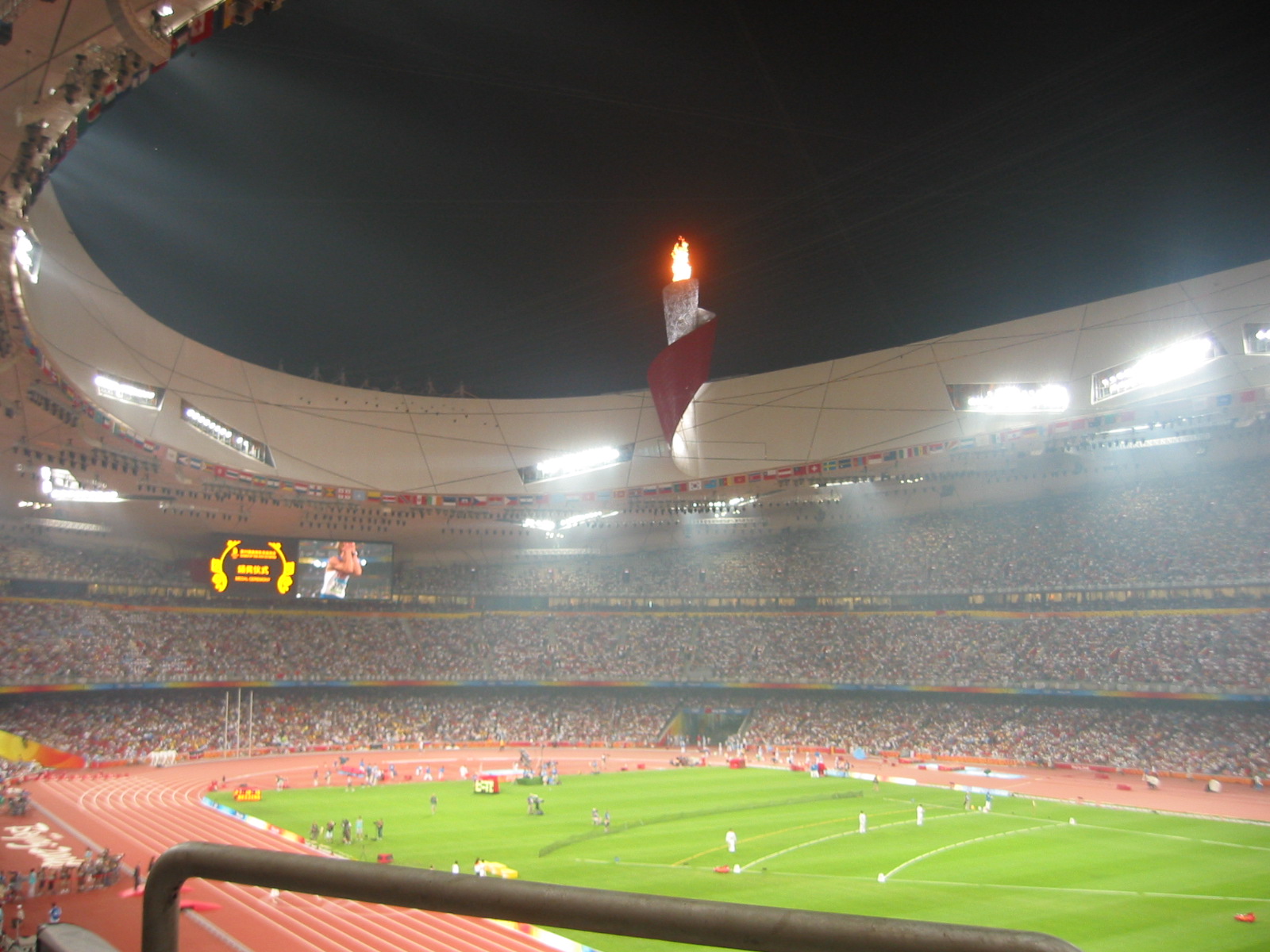
Yes, we know. The Sochi Olympics were a giant boondoggle, though not the $50 billion sinkhole that’s commonly reported. We know Beijing’s Bird’s Nest stadium (a twisted photo of which is in the SportsMyriad header) has no regular tenant, though it’s a fun place to visit and will soon host the track and field World Championships.
The Olympics can be badly planned. That’s the consensus on the 2004 Games in Athens, though some argue otherwise.
They can also be planned well, and venues can become thriving spots for, say, London tourists.
After the 2022 bidding debacle, in which the IOC’s overbearing insistence on regal treatment drove away every place that has viable snow and a world-class sliding track, everyone’s back in for 2024. Back to Paris? Rome?
Los Angeles! They did it before, albeit in a different era and without the Soviet bloc.
Want a good litmus test for hosting? Here’s one from Toronto Starcolumnist Bruce Arthur: “An Olympics is only worth it if it leaves your city better off than it found it, for a reasonable enough price.”
And it occurs to me that Los Angeles needs another soccer stadium, anyway …
If you build venues for the Pan Am Games, then tear them down or abandon them less than 10 years later when the Olympics come to town, you’re doing something wrong.
Olympic sports don’t get the coverage they deserve, especially in the USA. Even at the Olympics themselves, too many good stories go unreported. I’ve expended a lot of effort trying to rectify the situation, within the context of a major news organization and outside of one, but one person can only do so much.
At SportsMyriad, I’ve done medal projections for the 2012 and 2014 Olympics, and I rounded up some volunteers to do event-by-event coverage of the Sochi Olympics.
I’ve also found good feature stories. In 2008, I wondered how a tiny country like Iceland could be making such a big run in handball. I went out to explore and found a lively bunch of players with unusual quotes. I went back out to see then again in the semifinals and wound up meeting the president and first lady of Iceland. (Sadly, I was unable to cover the final, which they lost.)
I didn’t travel to the 2012 or 2014 Olympics, and 2016 looks unlikely. But I’d like to get back to it one of these years and do another whirlwind tour, finding and reporting good stories everywhere.
In the meantime, I’ll continue to do projections, and I’ll keep an eye out for good stories.
How the Hell Did I End Up Cageside?: An Accidental MMA Writer’s Memoir is in the early stages, though I have a bit of a headstart because it will incorporate several interviews I did for a book on The Ultimate Fighter.
Single-Digit Soccer: Keeping Sanity in the Earliest Ages of the Beautiful Game wasreleased electronically in August 2015, with a paperback edition released in September. It can be ordered on Amazon, Barnes and Noble, Apple or Kobo.
The book is a guidebook for parents and a reality check for coaches and administrators. It has colorful anecdotes from bumpy playing fields along with research, including interviews with top pro players and coaches, that questions the status quo and encourages families to find the best way to meet their needs in the sport.
See more at singledigitsoccer.com — including excerpts, a press release, a flyer and a video.
Enduring Spirit: Restoring Professional Women’s Soccer to Washingtonwas first released for Kindle and Nook but is now available at other outlets as well. The print version is available at Amazon.and Barnes & Noble.
To write the book, I followed Washington Spirit players, coaches and staff through the first season of the NWSL, from preseason tryouts to their final game of the first season. The team finished in last place, but the fans and players built relationships that have strengthened as the team has found more success over the next two years. And the book captures the struggle and sacrifice, leavened with good humor, that goes into building a team and building a sport.
Women’s soccer is more than just an occasional event on our TV screens in the summer. It’s an endeavor of hundreds of players putting aside higher-paying job opportunities to chase a dream and see how far they can go with their club teams while working their way into national team pools. The great drama of the U.S. women’s march to the World Cup trophy in 2015 was built in part from humble practice sessions on freezing fields and long bus rides after lost games. This book is not about the destination. It’s about the journey and the people who make it possible.
Long-Range Goals: The Success Story of Major League Soccer was first available, by sheer coincidence, the same day World Cup 2010 kicked off. It’s the history of the league from inception until early 2010, relying on extensive original interviews as well as the usual assortment of reports and documents.
The “success” of MLS is that it has survived so many obstacles. In the mid-1990s, betting money would have gone against the new league’s chances of outlasting every other attempt to make professional soccer take root in the USA. Then the league had to survive a thorny lawsuit and an economic downturn, and it still has to cope with staggering competition on the airwaves from soccer leagues around the world.
The book was well-received, and even though MLS has added a few more years to its history, I still hear comments and questions from new readers.
Never easy, but here’s what I’ve figured out so far from the WPSL site schedule:
Home teams listed first, where applicable.
West Region Champions of Northwest (Issaquah), Pac North (Spurs), Pac South (SoCal); plus Pac South runner-up (San Diego)
Playoffs (July 18) SoCal FC 5-0 Tottenham Hotspur Eastbay Ladies
Issaquah Soccer Club 3-1 San Diego SeaLions
Final (July 19) SoCal FC vs. Issaquah Soccer Club
East Region Champions of Northeast (Boston), Power 5 (New England), Mid Atlantic (Yankee); plus Mid Atlantic runner-up (Hershey) … news report said Seacoast United Phantoms would be in.
Playoffs (July 18) New England Mutiny 2-0 Yankee Lady FC
Boston Breakers Reserves 6-1 Hershey Soccer Club
Final (July 19) Boston Breakers Reserves 2-0 New England Mutiny
Midwest Region Champions of Midwest-Central (Chicago), Midwest-Great Lakes (Motor City) and Can Am (Empire); news report said Fire and Ice also would play
Playoff (July 17) Chicago Red Stars Reserves 5-1 Empire City FC
Final (July 19)
Motor City FC 0-2 Chicago Red Stars Reserves
2. Semifinals and final July 18-19, starting with
Sunshine vs. Southeast
Big Sky vs. South Atlantic
Sunshine played games listed as regular-season games July 11:
Tampa Bay Hellenic 4-1 Florida Sol FC
Florida Krush 0-2 Pinellas County United SC
Southeast played games listed as playoffs July 10: FC Nashville Wolves 4-0 Alabama FC
Knoxville Lady Force 3-1 Chattanooga FC
This Big Sky vs. Southeast game is listed as a playoff, not final (July 18) Knoxville Lady Force 0-2 Oklahoma City FC
According to WPSL Twitter, Oklahoma City FC qualified for national championship. They’re hosting.
South Atlantic champion ASA Charge played instead in the USASA National Championship with South Atlantic runner-up Fredericksburg FC, Power 5 runner-up New York Athletic Club, and something called Olympic Club. Winner seems to be Olympic Club.
So it appears we’ll have two NWSL reserve teams in the Final Four (meanwhile, the Washington Spirit Reserves are in the W-League Final Four), plus Oklahoma City FC and the West winner.
Not to take anything away from Carli Lloyd, a clutch performer of the highest caliber and someone who has worked very hard to get where she is, but something was missing in the Sports Illustrated cover story on her after the World Cup.
If you have yet to read the story, the upshot is that she got really upset after being cut from a U.S. youth team, so her family turned her over to James Galanis, who made her a good player by essentially telling her to quit the rest of her life.
“Forget about friends, forget about family, forget about boyfriends,” Galanis told her. “If this isn’t No. 1, let’s just walk off the field right now. What I’m saying to you, Carli, is that at 10 o’clock on a Saturday night, if I call you and say, ‘I’ll meet you at the field in half an hour,’ and you’re at a party with your friends, don’t tell me, ‘Sorry, Coach, I’m at a party.’ You’ll turn to your friends and say, ‘Sorry guys, I have to leave; I’m going to training.’ Do you understand the commitment here?”
Yikes.
We know hard work is part of world-class soccer. But there’s something else, something every bit as essential as running beep tests, maybe even more essential than ditching a party at 10 p.m. on a Saturday night because your private coach needs you right this very minute.
And like a lot of things in sports, that other essential thing can be found in an NSFW clip from Bull Durham:
Yes, fun. This game is supposed to be fun. FUN, BLEEP IT!
Who plays soccer and has fun? Megan Rapinoe, for one. She’s also the most creative player the U.S. women’s team has. That’s not coincidence.
Then there’s Crystal Dunn. If the USA wins the World Cup again in 2019 (FIXED from 2015 – see comments), maybe Dunn will get the nod for the big article, and we can hear how she streaked past a lot of dour German players for the winning goal. (Actually, that’s a stereotype — German legend Conny Pohlers is one of the funniest players I’ve ever encountered. But she’s retired.)
Dunn brought the fun to the SoccerPlex on Saturday night, tearing at the Seattle Reign’s back line and scoring a goal that looks like some sort of video game glitch in which a player suddenly zips from one part of the screen to the other:
— Our Game Magazine (@OurGameMagazine) July 19, 2015
The abrupt edit in that video doesn’t do justice to how quickly Dunn zipped past her defender to score that goal. It was as if a wormhole opened above the immaculate grass of the Maryland SoccerPlex just a few yards away from the beer garden.
“Oh sure, I’d have plenty of fun if I had wheels like Crystal Dunn,” you might say. But Dunn also plays a bit of joga bonito, the beautiful game. Look closely next time you see her with the ball, and you may see her make a subtle shift to unbalance her defender. Or she might put her foot on top of the ball as if she’s going to pull it back, only to slip it forward.
She’s got skills. And like an old-school soccer player who enjoys playing soccer, she likes to use them.
(Quick aside: Isn’t it funny that, for all the fuss over Anson Dorrance’s North Carolina program being behind the times and playing a physical brand of soccer while other college programs are focusing on soccer skills, three of the most skillful Americans — Dunn, Tobin Heath and Yael Averbuch — all played for Dorrance at UNC?)
And she’s a fun interview. She has a disarming self-effacing wit, joking about being caught offside so much. “I know I’m fast, but I just get so excited!” (I’m paraphrasing because my iPhone ate this interview. Bad, bad iPhone. Must have been worn out from all the tweeting I did on it while the Plex was Internet-less.)
Who else looks like she’s having fun out there? Diana Matheson. In her case, she’s just glad to be back after months of traumatic injuries. But she’s thrilled to be combining with Dunn as well.
Asked by Kevin Parker (@starcityfan) about that Spirit goal in which Matheson and Dunn took on four defenders, Matheson deflected all the praise to Dunn: “She probably took on three of them.”
Matheson also signed many, many autographs, as did many players. It was reminiscent of Abby Wambach after the 2011 World Cup, working her way through a line in Boston that snaked through the Harvard campus. Matheson didn’t mind, with one caveat:
“They were pushier, too. They were getting aggressive.”
So for the good of the fences at the SoccerPlex, maybe folks should back up a bit.
Other notes from the Spirit’s 3-0 win over Seattle:
– Seattle coach Laura Harvey’s comments could be summed up in three words: “We were poor.” She wasn’t angry, just stating the facts as she saw them.
– Washington coach Mark Parsons said he was wearing the same shirt he wore at the draft, when he also thought he got the better of Seattle and his good pal Harvey. My phone camera doesn’t do justice to how much he was sweating in that shirt on a steamy night at the Plex.
Parsons saw this game as a momentous achievement for the Spirit, stressing his respect for the Reign and Harvey. “Brave, intelligent and effort made that a complete performance. We’ve been striving to play soccer defensively like that, being hard to beat, hard to break down. … Offensively, we want to be a team that can build patient and can break and counter. I’ve said for a while until we beat a top team playing this style, we’re always going to fighting to get there. Tonight, we got there.”
– Speaking of the draft and the defense — at some point, those of us who cover the Spirit need to write about those players. Seattle’s Kim Little had her moments, but second-round pick Megan Oyster and fourth-rounder Whitney Church slammed the door on the top-scoring team in the league, and it’s no fluke. They’re only getting better. Estelle Johnson and Katherine Reynolds provide the experience, and now Ali Krieger and Ashlyn Harris are coming back into the lineup. The defense hasn’t often been seen as the Spirit’s strength, but we might need to rethink that perception.
– Women’s pro soccer SoccerPlex record 5,413 saw the game. The Spirit should probably take a page out of the Freedom’s book and put some concessions and portable toilets on the far side of the field as well when they’re expecting a crowd of that size. The concourse was borderline impassable at halftime, and I’m sure much of the crowd missed the first Spirit goal less than a minute into the second half.
Marion Reneau is just the latest MMA fighter who says she’s fighting to support her family / give her family a better life:
UFC women’s bantamweight contender Marion Reneau, who is pushing 40, started MMA in her early 30s to help finance her son’s college fund.(From MMA FIghting)
Let’s take a look at the money available in the UFC …
UFC 189, one of the biggest cards in history, paid most of its fighters $10-15K to fight, plus the same amount as a win bonus. (Conor McGregor made a bit more. Just a bit.)
Reneau was actually on a lower pay scale, the dreaded “8+8” scale, for her January fight. She got a bit more because her opponent turned up overweight.
I can’t find the numbers for her February fight, possibly because it was in Brazil. She did get a $50,000 performance bonus.
Then there’s sponsorship. With the Reebok exclusivity, a fighter like Reneau will make $2,500 per fight. A couple more fights, and she’ll make $5,000.
So she might gross $100,000 for the year so far. Not bad, right?
Now consider the following factors:
Fighters are paying managers, corner personnel, trainers, etc.
This might be a once-in-a-lifetime year for Reneau. Her loss last night to Holly Holm, in an unimpressive fight, put her back down the ladder. Half of her income is one performance bonus — if another fighter had a more impressive knockout or submission on that card, she wouldn’t get that money.
Many fighters don’t get three fights a year in the UFC. The roster is too crowded.
So Reneau might clear six figures if she has some other sponsorship that she can tout outside the Reebok-only cage. Or maybe she wins the virtual lottery to get a rare fourth fight this year.
Then next year, she might get two fights and end up with about $30K. And she’s almost 40.
Reneau’s other job was teaching in the Farmersville (Calif.) Unified School District. Minimum salary: $41,485.
This post isn’t about picking on Reneau, though. She picked up a nice bonus. Invest that wisely, then get back to teaching and push that salary into the $50Ks, and she’s on firm footing financially.
Reneau’s plan is much sounder than that of the typical UFC fringe performer you see on The Ultimate Fighter. These are the people who stare into the camera, cry a little and tell us they’re fighting so their families will have a future.
If you’re telling me that, please tell me you have a backup plan.
Reneau is both good — she’s one of the 20 best in her weight class — and lucky. That gets her one good year of solid earnings. A second is no sure bet.
So if you’re the 10th best welterweight in your gym, please do your family a favor and make sure you’ve got some way to make a living other than fighting.
— UltraViolet is not paying for this (@UltraViolet) July 10, 2015
That plane flew for three hours, over this route:
So here are some questions:
Is this the most effective means of protesting?
What’s the goal?
What’s the likely outcome?
Maybe I haven’t spent enough time in Manhattan, but I’m a little skeptical of an airplane banner as a means of protest with such a distracting skyline. When I think of airplane banners on the beach, advertising the latest seafood specials nearby. Planes sometimes fly over stadiums in an effort to get the coach fired. (I know, I know — the pro/rel guy wasted some money on it as well.)
But UltraViolet also brought its message to ground level, which looks a little more effective from a distance:
Another issue: Is this really taking the message to FIFA? To my knowledge, no FIFA officials went to New York to honor the U.S. team. I’d hope the money went toward the parade, not putting up some Executive Committee member in a five-star hotel. And it’s a safe bet Sepp Blatter wasn’t there.
Perhaps, though, the banners will inspire some people to join UltraViolet’s more conventional (by 21st century standards) protests, petitioning and reaching out through social media. Molly Haigh, whose tweet you see above, explained by email:
FIFA officials have been hearing from our members since we launched this campaign–in the form of petition signatures, comments, phone calls and social media outreach–and that will continue as we go forward.
The next question: Is pay equality an attainable goal? In some sports, yes. If you’re the overall winner in your discipline in track and field’s Diamond League, you get $40,000 and a nice trophy, whether you’ve won the men’s 100 meters or the women’s triple jump or anything else. Grand Slam tennis champions get equal pay, even though women play only three sets max.
Most individual sports in this BBC study were even — the exceptions were golf, ski jumping (if you don’t remember that fight, refresh your memory), certain cycling events, and the one we’re talking about here, football.
So give the International Olympic Committee and international organizations some credit. In most of our lifetimes, female Olympic athletes have had as much access to fame and fortune as the men. Think Lindsey Vonn, Michelle Kwan, Marion Jones, Misty May/Kerri Walsh, and so on. Even a Romanian like Nadia Comenici can garner global attention.
Team sports are trickier.
Part of the issue: Men’s team sports are huge. Gargantuan. Immense vortices of money and media. The Women’s World Cup does well in the USA. The men’s World Cup does well in every country with functioning televisions.
So asking for equality on the World Cup front is tough. We might be better off asking why FIFA gives prize money at all rather than sinking the revenue back into developing the game. Men’s players may strike if their home federations aren’t paying them (sadly, not all that rare), but I don’t think anyone is going to pass up the World Cup because the bonus money isn’t high enough.
In women’s soccer, the national team players in the USA and several European countries aren’t the ones who need the money. It’s everyone else.
Women’s soccer needs to catch up in so many ways. One is the talent pool for the national team. The U.S. men have entire camps in January — the now-legendary “Camp Cupcake” — that bring fringe players into the mix. Aside from Stanford player Jordan Morris, all of the men have solid salaries in MLS or Europe.
In other words: Women’s soccer needs the NWSL. We need an expanded player pool. We also need players to compete. The rust on Abby Wambach’s game during this World Cup should reinforce the importance of playing club competition, as other players were doing while Wambach trained on her own.
No one wants to be the one to advise well-intentioned protesters to scale back their demands. “A dream deferred is a dream denied” and so forth. In this case, though, it’s not necessarily a question of letting FIFA off the hook. FIFA does women’s soccer wrong in general. By all means, keep yelling at Zurich.
But the more immediate need is right here. The bonus money for U.S. national team players is as much about symbolism as anything else. The pressing problem is the salaries for NWSL players, many of whom play for less than $10,000 a season.
That needs to change. And you don’t get that done by yelling at people who’ve given a lot of money already to give a lot more. You get that done by getting the tens of millions of people who followed the Women’s World Cup in the USA to pay at least a little bit of attention to the league.
UltraViolet does have plans on that front, Haigh says: “Our members will be making their voices heard to any and every entity that has a stake in women’s soccer. We are huge fans.”
Great. Because if we don’t have a professional league in this country, U.S. players and fans are far less likely to see whatever checks they’re handing out to the winners, anyway. The countries that have figured out how to play pro soccer will gladly pocket that money.
The UFC couldn’t have picked a better night to unveil its new look.
Let’s face it — the UFC of a few years ago was big but a little predictable. Georges St. Pierre would take people down at will or methodically jab them to a pulp. Anderson Silva would dance around a little and win with a Matrix-style move if he was interested or win methodically if he was bored. Brock Lesnar would take someone down and pound them with the giant ham hocks he calls fists.
The stars faded, and the UFC seemed to be fading with it. A lot of up-and-coming fighters were boring wrestlers who just leaned against opponents on the cage. The recurring feature on The Ultimate Fighter is now Dana White’s exasperation with fighters who show little fighting spirit but just try not to lose.
Tonight, we got a new perspective on the UFC. Part of it was the UFC’s production — new graphics, the Octagon used as a video screen, live music for the main event. Part of it, sadly, was the personality-killing Reebok gear that makes everyone look like a character in the original Rollerball, in which the corporation tried to make sure no athlete stood out from the gladiatorial spectacle.
Then part of it was a wild main card — a bloody showcase for a sport that has reached new heights of competitiveness.
We got hints early in the main card. Massive underdog Brad Pickett picked apart Thomas Almeida until the young Brazilian landed a knee that sent Pickett tumbling backward to the mat. Jeremy Stephens was also bloodied before landing a flying knee of his own.
The co-main event was an instant classic title fight. It’s hard to imagine that, just a few years ago, Robbie Lawler looked like a plodding journeyman. Now he has had two terrific title bouts with Johny Hendricks, winning the second to take the belt. Tonight, he made an utter mess of Rory MacDonald’s face but absorbed some punishment himself through four rounds. He was trailing on all three judges’ scorecards:
He might not have known he needed a knockout, but that’s what he delivered, landing a left hand that sent MacDonald down slowly, as if his ability to fight back was ebbing from his body.
Each of those fights was a compliment to the competitive spirit of today’s elite UFC fighters. We see so much mixed martial arts on television that we forget what these top-tier fighters are capable of doing.
And that led us to … Sinead O’Connor. Really. She sang for the entrance of the favorite son of Ireland and possibly my distant relative, Conor McGregor. (I’m related to the McGregor clan of Scotland, which finished third in a two-way power struggle in the Scottish highlands. Maybe some of us hopped over the water and found a better life in Ireland?)
So far in his career, McGregor’s mouth has outpaced his fighting accomplishments. He has long talked as if he already had a UFC belt, and he broke all manner of protocol by grabbing the belt at a press conference.
But when he actually earned the belt, coming back from a ground-and-pound onslaught by Chad Mendes to get the knockout late in the second round, we saw a more humble McGregor. He and Mendes showed the sportsmanship we’ve come to expect from most UFC greats. And he seemed to realize he might not have made it through the fight without the support of the massive hordes of Irish fans who wildly cheered for him.
McGregor might not be the best fighter in the featherweight division. He showed some holes in his game against Mendes, a late replacement for injured champion Jose Aldo. With a full training camp, Mendes might beat him. So might Aldo, when the champion faces the interim champion in a bout that should approach Lesnar-type pay-per-view numbers. Frankie Edgar should also be in the conversation.
And on a given night, Lawler might lose. He was down tonight. He barely beat Hendricks.
But these fighters fully deserve their belts. The fact that they’re not as dominant as Silva or St. Pierre in their primes just means we might be getting better and better fights.
New presentation. New clothes (though they need to work on that, along with the contracts behind them). New competition.
The next few years should be as thrilling as any we’ve seen in combat sports.






 Duresport.com