soccer

Garbage in, garbage out: Soccer analytics and economics

Academia and sports each have a tension between number-crunchers and those who believe the numbers simply can’t capture the real world.

We in the media are ill-equipped to cover this dispute. We’re generally not good at math. Twice, I’ve had to explain to a fellow journalist that 1/4=0.25. (“Do you have a quarter in your pocket?! How many cents is it worth?!!!”)

When I say I’m farther along in math than probably 95% of journalists, I’m not bragging. I’m highlighting a problem. I did really well in AP Calculus in high school. That got me one semester of math credit at Duke, and I took a second semester of calculus. (In which I did not do really well, though in my defense, my teacher wasn’t so good at communication.)

In retrospect, I would’ve taken a statistics course. Or two or three. That’s about all anyone can take without taking linear algebra, for which that second semester of calculus is a prerequisite. (Yeah, I passed, but I wouldn’t have been very comfortable.)

screenshot-2016-12-07-at-1-47-50-pm
There’s an app for that.

I’ve actually enrolled in a series of Data Science courses from Johns Hopkins via Coursera. So far, I’ve learned how to download the programs that I can use to do data science.


So I am not capable of saying much about this analysis of the MLS Audi Player Index by sports analytics student Kevin Shank other than to say I wholeheartedly agree with a saying mentioned herein that I always heard in my computer science class (now otherwise totally outdated) and other endeavors involving numbers and programming:

Garbage in, garbage out.

A lot of soccer journalists would go farther than that and say numbers can never, ever fully describe the impact of a soccer player. They might lack the mathematical background to critique anyone’s linear algebra and mathematical modeling, but they’re not necessarily wrong.

To give another college story, I was in a class called Symbolic Logic, which I took because (A) I was a philosophy major, and this was a philosophy class and (B) I had done so well in Logic. But the way it was taught at Duke at the time, this was no philosophy class. This was an advanced math class. The professor was startled to learn that a couple of us hadn’t done mathematical induction before. To which I was tempted to reply, “Then make the relevant math class a freaking prerequisite so we won’t sign up for this thing and torpedo our GPAs with a class that will take all of our efforts just to pass.”

I mention it because the professor did mention that Immanuel Kant was skeptical of some of the tools we were learning. So it was awfully tempting to sit down for the final exam and write “Kant was right,” then get on with the rest of my exams.

So a lot of journalists would say the equivalent of “Kant was right.” And with good reason. We can argue how well or how poorly numbers can tell the story of a soccer player’s success. One school of thought insists that the amount a soccer player runs in a game, a new metric you’ll see on sophisticated broadcasts, is less of a measure of a player’s work ethic and more a measure of tactical naivete. In other words, maybe that player is running so much because he/she doesn’t know how to play the danged position and is always in the wrong spot.

I would say analytics are useful — to a point. I don’t get too excited about the Audi Player Index because I have no idea what it’s supposed to measure. Telling me a player completed only 50% of her passes from midfield — OK, that I can understand. And yet that player may still be valuable for reasons that can only be described subjectively. Until someone can quantify the impact of Abby Wambach dropping the f-bomb in the locker room (new stat idea: Carli Lloyd goals per Wambach curse words), we’re going to face limits to what numbers can describe.

And that brings us to a field I have long disparaged: Sports economics.

It’s not that economists have nothing to offer the sports world. Frankly, someone should’ve sat down with the people who bought the UFC and explained to them what will happen to TV rights fees as ESPN, Fox Sports and company try to adapt to cord-cutting.

But we’re more likely to hear from sports economists in the context of players wanting more money. Nothing inherently wrong with that, but these economists tend to rely on the same assumptions as the players.

Soccer America columnist Paul Gardner had the classic retort as he watched an economist testify in the MLS players’ lawsuit at the turn of the millennium: “For an entire session, this totally fictitious exercise dragged on, as the good Professor Zimbalist revealed charts and calculations to ‘prove’ what must have happened had a whole series of improbable conditions existed. They never did exist.” (See the original column as a PDF, which also features MLS players absurdly testifying that they don’t know whether the “First Division” in England was the equal of the Premier League, and check out a free excerpt of my book in which this quote plays a key role.)

Gardner, to my knowledge, has no economics degree. But he had significantly less faith in the APSL’s ability to rev up a price war with MLS than Andrew Zimbalist had. And Gardner knew quite a bit more about the APSL than Zimbalist did.

“History simply trumps economics” is an argument I’ve made before. I made it in a discussion with Soccernomics’ Stefan Szymanski a couple of years ago. I appreciate his willingness to engage on the topic, but I stand by my objections. The tools he’s using to analyze U.S. soccer’s growth and potential are simply insufficient, no matter how sound the math may be. (Example: He argues that U.S. soccer resources will not grow much faster than Belgium’s because the U.S. economy won’t grow much faster than Belgium’s. But Belgium is a mature soccer nation and the USA is not. And the USA has a unique capacity to lure players — I can’t quantify the numbers that lead a Giovinco, a Bradley or a David Villa to play in North America instead of Europe, but lo and behold, they’re here.)

But the Soccernomics folks have a lot to add to our soccer discourse in this country, and this week, their blog offered up a terrific piece: “US Soccer and Conflicts of Interest.” And I’m not just saying that because it coincides with my deep dive into U.S. Soccer Federation governance.

Colorado academic Roger Pielke raises some good questions. The soccer community at large won’t spend much time discussing whether the “Risk, Audit and Compliance Committee” can suffice as an “Ethics Committee.” But we have plenty of talk on this one: Should U.S. Soccer’s officers and board members have fewer ties to Soccer United Marketing, the MLS-affiliated company that has rights to so many soccer broadcast properties, both domestic and foreign?

Here’s the part that tripped me up: “The business and non-profit functions currently under the umbrella of US Soccer should be clearly separated into completely separate organizations.”

I initially read this as suggesting USSF should split into separate federations, one business and one non-profit. I can’t imagine how that would work, and I think FIFA’s reaction would be a multilingual “Huh?” But another way to look at it is simply separating SUM from USSF as much as possible. I don’t think you could do it entirely — I can’t imagine the USSF board operating with no MLS representation, and MLS representation means having an implicit tie to SUM. Yet some sort of firewall, like the one newspapers traditionally have between its business and news operations, might make sense. The devil would be in the details.

Pielke says USSF president Sunil Gulati and others with the federation have been receptive to his ideas. That’s good. Because I’m going to have a lot of follow-up questions.

Featured image is from Kevin Stark’s Tableau page. I have little idea what that means, but I hope I’ll know in a few months.
soccer

Hey hey, ho ho, U.S. Soccer Bylaw 109(7) has got to go

The U.S. Soccer Federation is many things to many people. And you can’t please all of the people all the time. (Mitch Hedberg: “And last night, all those people were at my show.”)

When U.S. men’s coach Jurgen Klinsmann was dismissed last month, The New York Times felt compelled to point out that the man most responsible for hiring and firing him, Sunil Gulati, did not occupy a position from which he could be easily “fired.” He’s an elected official, like a school board chair or a member of Congress.

Sam Borden writes:

Because U.S. Soccer is a nonprofit body that oversees all facets of the sport in the United States — as opposed to a for-profit professional sports team or league — its most senior positions are elected posts held on a volunteer basis. Gulati’s primary job is being an economics lecturer at Columbia; on Sunday, in addition to weighing Klinsmann’s fate, he taught a makeup class.

Yes, there are procedures by which Gulati could be removed by U.S. Soccer’s board of directors, but such impeachments are highly unlikely and generally designed for situations in which a board member has done something illegal.

So that should make everything perfectly clear, right? “Stand Down Sunil” would be a much more apt rallying cry than … oh …

https://twitter.com/ChicagoNASLFans/status/805192597178318848

Yes, the Nutmeg News satirical piece this week (“Man Pretty Certain His Two Bedsheets Are Going To Change The US Soccer Federation”) was based on something that actually happened.

This display was, of course, not motivated by Klinsmann’s hiring or firing. Or the ongoing labor dispute with the U.S. women’s soccer team, for which I’ve been tempted to hang a couple of sheets saying “Someone answer my danged emails!” Or even the tension between the long-standing youth and adult state associations and these newbie professionals who have increased their power within the organization in the 20 years of Major League Soccer’s existence.

The second bedsheet gives the simple agenda: “PRORELFORUSA,” or promotion and relegation.

And the pro/rel folks are trying to get that issue higher up on the USSF to-do list, though “pay current and former coaches” and “figure out how to counter the 60 Minutes piece on the women’s team” are going to be pretty tough to top for the next few weeks, at least.

The current agitation over pro/rel is a result of the decline or possibly even demise of the NASL, the league that managed to pitch itself to pro/rel zealots even while (A) never taking any tangible steps toward even thinking about working in such a system and (B) reviving brand names of the least traditional professional league for which we have any records. The New York Cosmos of 2016 were the improbable banner behind which pro/rel fans marched. The New York Cosmos of 1978 played on thin artificial turf covering narrow fields, with ties decided by alternating 35-yard shootout attempts, little to no interest in traditional cup competitions (which today’s NASL fans ironically accuse MLS of neglecting), and league standings riddled with “bonus points.”

Yes, it’s a bit like Garth Brooks doing an album of disco covers. We’re not dealing with the most-informed set of protesters here.

All that said, with all the issues facing U.S. Soccer today — the women’s pay, support for the NWSL, the chaos of the men’s lower divisions, the Girls Development Academy vs. the ECNL, the shocking performances by U.S. youth teams, the poorly received youth soccer mandates, etc. — perhaps it’s time for a broader discussion?

To that end, I’m immersing myself in all sorts of U.S. Soccer arcania such as Annual General Meeting transcripts, which are mostly discussions of Robert’s Rules of Order, bylaw revisions, and long roll calls.

I did not attempt a screen capture of the 2003-04 showdown in which youth groups accused the pro representatives and the athletes (who are required to have at least 20% of any vote, per U.S. Olympic Committee rules) of voting as a bloc to deny them any ability to challenge anything. That went on for many pages, and that’s just in the approved minutes and transcripts of the meetings.

Here’s what I hope to find out:

  1. What can change within U.S. Soccer?
  2. What should change?
  3. How can that change be made?

I hope the final results will shed some light on an organization shrouded in mythology. The conspiracy theories are a bit silly; the issues are not.

In fact, we may on the verge of a real opportunity for pro/rel. If the USL takes Division 2 status, then maybe what’s left of the NASL teams can join a few others and start proposing Division 3 leagues that include pro/rel. Some people think the federation should simply impose pro/rel on all the existing leagues, which would be a good way to make sure every dollar spent on U.S. soccer in the next 10 years goes to someone’s law firm. Much better to come up with an actual, feasible proposal and force the federation to either support it or oppose it. (The USL did limited pro/rel way back when, but the league standards and the process for gaining the federation’s sanction have certainly changed since then.) And we’re starting to see reasonable people trying to find a way to make pro/rel work instead of just collecting funds for no defined purpose or shouting at people on Twitter all day.

Make no mistake — U.S. Soccer might be a difficult boat to rock, and perhaps some people should be careful what they wish for. Over the past 10 years, a lot of line items in the budget have roughly tripled — sponsorship, national team revenue and national team expenses. That’s a robust organization, quite a change from the days of irrelevance in the 60s, 70s and 80s. (Not coincidentally, the USA did not qualify for a World Cup in those decades.)

But this seems as good a time as any to peek into USSF governance. If you have any questions (or better yet, some answers), just holler. Please don’t hang any sheets outside my house, though — I like my neighbors.


work portfolio

Save newspapers, save the world

I try to steer clear of politics, mostly for professional reasons.

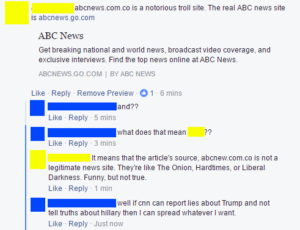
But this, to me, isn’t about simple politics. This is about our fundamental ability to discern fact from fiction. It’s been under assault for decades — my thesis, published in 2000, warned us that we were in danger of retreating to misinformed echo chambers. (I wish that term had been in vogue at the time. It would’ve saved me some exposition.)

So please don’t interpret this piece, a roundtable with me and several other veteran journalists at Popdose, as simple Trump-bashing or left-wing fretting. We should all be concerned about attitudes toward the media.

The media need watchdogs, sure. But how did we reach the point at which we trust some obviously partisan person doing no original reporting over honest investigations requiring many people to do a lot of digging and checking?

We journalists tend not to stick up for ourselves. It’s hard to imagine another product that always prints criticisms of that product ON that product. (I’m referring to letters to the editor, and my historical research concluded that they weren’t any smarter or nicer in the 1960s.) And with rare exception, we don’t even respond. If someone calls me all sorts of nasty names — and yes, it happened even before the Internet made it easy — I’m supposed to sit back and take it.

I’m not sure we can do that any more. What we do is valuable. We can — and should — defend our work. We can’t just do the politically correct thing and listen patiently as every wingnut on the planet (and yes, this includes many on the “left” as well as the various factions fighting to be the “right” these days) takes shots at us that we can easily refute.

Call it elitist if you want. All I can tell you is that I’ve worked with hundreds of people who put their work ahead of their politics, and they make an honest effort to get at the truth. And they’ll listen to constructive feedback. If you tune them out and listen to some deranged cartoonist instead, you’re choosing unwisely.

Source: Popdose Roundtable: Saving the Media in a Post-Fact World